
Resources For the Deaf

Learn more
Learn more
Learn more
Learn more
Learn more

Resources for Venues & Event Organizers

Preparing Performing Arts Venues for Deaf Audience Members & ASL Interpreters

  1. Creating an inclusive environment for Deaf and hard-of-hearing patrons is essential to equitable access in the performing arts. This guide provides best practices, logistics, communication strategies, and resources to support venues in preparing for Deaf audience members and working effectively with American Sign Language (ASL) interpreters

Download the full Resource Guide (PDF)

2.1 Identify Access Needs Early

  • Add an accessibility question during ticket purchase (e.g., “Do you need ASL interpretation or other accommodations?”).
  • Maintain a simple process for requesting ASL interpreters, including deadlines for requests (commonly 2–3 weeks prior).
  • Provide clear information about accessible services on the venue’s website.

2.2 Arrange for Qualified Interpreters

  • Contract certified ASL interpreters with experience in performing arts.
  • Ensure interpreters have access to:
    • Scripts, lyrics, and program notes
    • Audio recordings (if applicable)
    • Rehearsal videos or run-throughs

If multiple interpreters or teams are engaged, designate an interpreter coordinator, or request one through RISE.

2.3 Coordinate with Production Staff

  • Schedule interpreter rehearsals or practice sessions with stage managers.
  • Confirm cue sheets so interpreters can sync with lighting, music, and staging.
  • Discuss sightline considerations, interpreter lighting, and stage placement.

3.1 Interpreter Positioning

  • Interpreters should be:
    • Well-lit (but not blinded by spotlight)
    • Visible from reserved Deaf seating sections
    • Stationed where they can see actors, screens, and cues

Use consistent, even front lighting; avoid color washes that reduce visibility.

3.2 Seating Arrangements

  • Reserve seating areas providing:
    • Direct line of sight to both interpreters and the stage
    • Minimal obstructions (balconies, railings, columns)
  • Mark accessible seating on the box office system and notify ushers in advance.

3.3 Assistive Listening Options

Even if ASL interpretation is offered, some Deaf/hard-of-hearing patrons may prefer:

  • Assistive listening devices (ALDs)
  • FM or induction loop systems
  • Captioning (open or closed)

Have staff trained to distribute and troubleshoot equipment.

4.1 Staff Training Essentials

All ushers, box office staff, and volunteers should know:

  • Basic communication tips:
    • Face the person directly
    • Speak clearly at a normal pace
    • Avoid covering your mouth
    • Use gestures or writing if needed
  • How to guide patrons to ASL-interpreted seating
  • Proper etiquette around interpreters:
    • Interpreters are not “performers”—they work to provide access
    • Interpreters should not be redirected, moved, or put on the spot

4.2 Signage and Programs

  • Clearly display signs indicating the ASL-interpreted performance.

If possible, provide visual announcements in the lobby or pre-show screens.

5.1 Best Practices

  • Provide all materials early, in accessible digital formats.
  • Offer a private greenroom or preparation space.
  • Check in with interpreters pre-show for any last-minute adjustments.

5.2 Interpreter Teams

For longer or more complex productions:

  • Use team interpreting, where two interpreters switch roles every 20–30 minutes.

Have clear plans for transitions to ensure smooth delivery.

5.3 Technical Considerations

  • Avoid placing interpreters in shadows or flashing lights.
  • Coordinate with sound and lighting crews to maintain consistent visibility.
  • If filming or live-streaming:
    • Ensure interpreters remain in frame
    • Use picture-in-picture options when appropriate

6.1 Visual Alerts

  • Provide visual alternatives for announcements normally delivered over audio (e.g., house open, late seating, emergency instructions).
  • Present emergency information via:
    • Digital screens
    • Flashing lights
    • Instructions from staff trained to gesture clearly

6.2 Flexible Seating for Interpreters

Ensure interpreters can see:

  • The full width of the stage
  • Cue lights
  • Projection screens or surtitles
  • Critical entrances/exits

7.1 Feedback Collection

Invite Deaf patrons to share their experience:

  • Quick survey with visual formatting
  • QR codes linking to accessible forms
  • Ask about visibility, interpreter quality, and overall experience

7.2 Debrief with Interpreters

Discuss:

  • What worked well
  • What challenges occurred
  • Improvements for future shows

7.3 Accessibility Reporting

Document each ASL-interpreted event:

  • Seating configuration
  • Interpreter team used
  • Patron feedback
  • Technical notes
    Use this record to improve processes and build institutional knowledge.

8.1 Marketing Accessible Performances

  • Promote ASL-interpreted shows with:
    • ASL video announcements
    • Social media posts using #ASLinterpreted or #DeafAccessible
    • Clearly labeled events on the venue website

8.2 Community Engagement

  • Partner with local Deaf organizations and schools.
  • Host “Deaf Nights” or talkbacks with interpreters.
  • Offer ASL tours for backstage or lobby exhibitions.

Accessibility Standards

  • ADA Title III Accessibility Guidelines
  • Web Content Accessibility Guidelines (WCAG) for online content

Deaf Culture and ASL Learning

  • National Association of the Deaf (NAD)
  • Local Deaf community centers
  • Gallaudet University online ASL resources
  • If Deaf patrons cancel their attendance, the venue should also cancel the ASL interpreters immediately.
  • If interpreters are not canceled with sufficient notice, they will bill for the full show.
  • Communicate all changes promptly to the RISE Interpreting team.
  • Provide as much notice as possible to avoid unnecessary charges.

Summary Checklist

Before the Show

  • Confirm interpreter booking

  • Provide script/music/notes

  • Assign interpreter placement & lighting

  • Reserve Deaf-friendly seating

  • Train front-of-house staff

During the Show

  • Ensure interpreters are visible & well lit

  • Keep Deaf seating unobstructed

  • Maintain visual alerts for announcements / emergencies

After the Show

  • Collect feedback from Deaf patrons

  • Debrief with interpreters

  • Document setup & improvements for next time

Need support planning an accessible performance? We’re happy to consult with your team.
Request an Interpreter Get an Estimate

Self-Advocacy Cards

To better serve our Deaf clients, RISE has created a card to help educate others on how to best communicate with D/HH. Request a packet of free cards today!

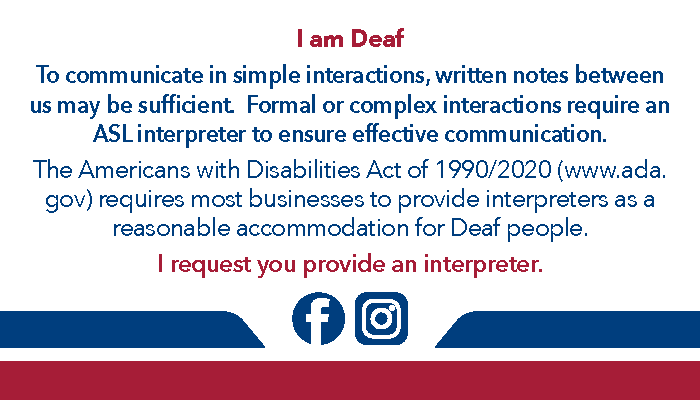
Text on the card:

I am Deaf

To communicate in simple interactions, written notes between us may be sufficient. Formal or complex interactions require an ASL interpreter to ensure effective communication.

The Americans with Disabilities Act (www.ada.gov), requires most businesses to provide interpreters as a reasonable accommodation for Deaf people.

I request you provide an interpreter.
download self advocacy card download Advocacy letter vri card

Frequently asked questions
for the Deaf / Hard of Hearing

Request an interpreter from the business where you need communication.  The American’s with Disabilities Act and other laws generally require that business to arrange an interpreter for you at no cost to you. 

If it is their first time using an interpreter, please have them contact us:
www.RISEInterpreting.com  (951) 565-4422 Voice  (951) 208-6886 VideoPhone

Yes, we do charge an hourly fee for interpreting services.  VRI requests are usually a 1-hour minimum and on-site requests have a 2-hour minimum.

As soon as possible.  We recommend requesting an interpreter at the same time as you schedule your meetings or appointments.  

Yes. Please ask for your preferred interpreter when making your request. It is not guaranteed but we will do our best to honor your preference.  

Yes. With advance notice, we can usually accommodate gender preference.

Confirmations are emailed to the customer who requested services.  Please follow up with them to ensure they have arranged an interpreter. 

Yes! Yes! Yes!

  • RISE sponsors many Deaf Community events
  • The owners and most office staff are fluent in ASL
  • The owners and staff have Deaf family (see Meet the team)
  • Several staff volunteer interpret on a regular basis
  • Staff serve on ASL Advisory Committees for local schools and colleges

Yes, we always want to hear from you!  Please share your feedback directly with the interpreter or our office:

feedback@riseinterpreting.com

(951) 565-4422 Voice    (951) 208-6886 VideoPhone

Please call us to discuss. We can note that interpreter as “Not Preferred” moving forward. 

We can also add any of your favorite or preferred interpreters!

Start bridging the gap

Are you ready to communicate more clearly through professional, engaging ASL interpreting? Call us today to request an interpreter.

CALL (951) 565-4422 Request an Interpreter